Greedy Algorithms
约 650 个字 41 行代码 5 张图片 预计阅读时间 5 分钟
- Optimization Problems 最优化问题
Given a set of constraints and an optimization function. Solutions that satisfy the constrains are called feasible solutions. A feasible solution for which the optimization function has the best possible value is called an optimal solution.
- Greedy Method 贪心算法
Make the best decision at each stage, under some greedy criterion. A decision made in one stage is not changed in a later stage, so each decision should assure feasibility.
也就是说,求的是局部最优解。
Note
- 当且仅当局部最优解等于全局最优解的时候,贪心算法才成立。
- 贪婪算法不能保证最优解。但是,它通常会产生非常接近最优解的值,因此当寻找最优解需要花费太多时间时,它直观上很有吸引力。(之后讲approximation的时候会讲到)
Activity Selection Problem
Given a set of activities \( S = \{ a_1, a_2, \ldots, a_n \} \) that wish to use a resource (e.g., a classroom). Each \( a_i \) takes place during a time interval \([s_i, f_i)\).
Activities \( a_i \) and \( a_j \) are compatible if \( s_i \ge f_j \) or \( s_j \ge f_i \) (i.e., their time intervals do not overlap).
Now our goal is to select a maximun-size subset of mutually compatible activities.
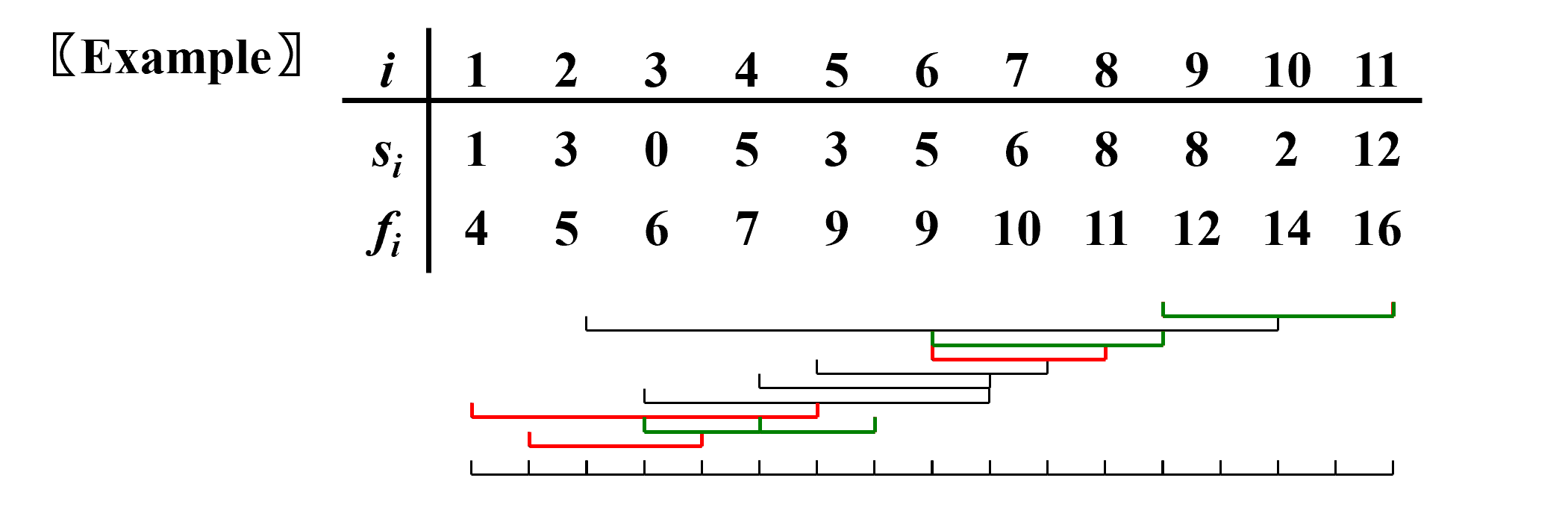
DP
我们可以用动态规划来解决这个问题。将一系列活动\(a_1, a_2, a_3 \cdots a_n\)中取出一个\(a_k\),那么最优解就可以表达为以下式子:(其中\(c_{ij}\)表示的是从活动i到活动j之中最大兼容的活动)
我们不难看出此时的复杂度是\(O(n^2)\),这花销很大。
Greedy
动态规划的时间复杂度太高了,因此我们可以考虑贪心算法。
Greedy Rule 1
Select the interval which starts first.

Greedy Rule 2
Select the interval which is the shortest.

Greedy Rule 3
Select the interval with the fewest conflicts with other remaining intervals (but not overlapping the already chosen intervals).

Greedy Rule 4
Select the interval which ends first (but not overlapping the already chosen intervals).

对于该问题,贪心算法的原则是局部决策选取结束时间最早、且与目前已确定举办的活动无时间冲突的活动。
因此,对于贪心算法,我们仅需要对活动按照结束时间进行排序,再对其进行一次遍历即可得到结果。其中,排序时间复杂度为\(O(N\log N)\),遍历时间复杂度是\(O(N)\),总时间复杂度就是\(O(N\log N)\)。
下面给出伪代码:
| C | |
|---|---|
1 2 3 4 5 6 7 8 9 10 11 12 13 14 15 16 17 18 19 20 21 22 23 24 25 26 27 28 | |
Huffuman Codes
离散中已经学过了。每个数只能存在叶节点,来保持其前缀码的特性。
| C | |
|---|---|
1 2 3 4 5 6 7 8 9 10 11 12 13 | |
正确性我不会证明(惭愧)。